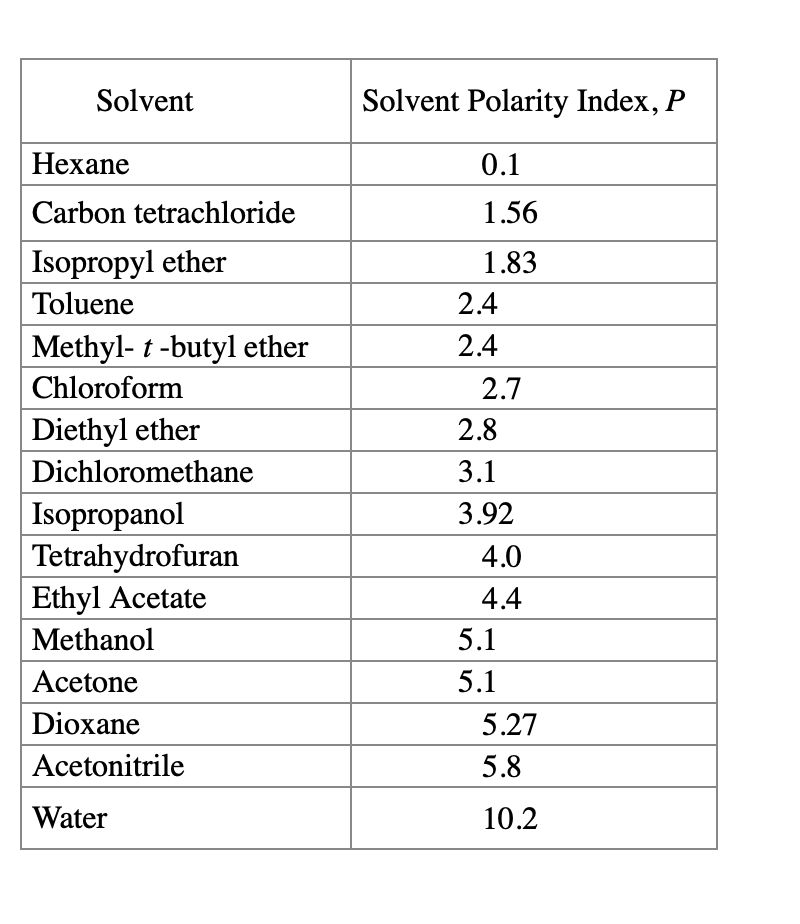
Polarity Of Solvents Chart
Polarity Of Solvents Chart - For example, the hydrogen atom in hydrogen chloride is slightly. The polarity of a bond arises from the relative electronegativities of the elements. Polarity is when an entity contains two distinct and opposite poles that can either attract or repel each other. Electronegativity is the power of an atom of an element to attract electrons toward itself when it is part of a. Scientists have devised a scale called electronegativity, a scale for judging how much atoms of any element attract electrons. The meaning of polarity is the quality or condition inherent in a body that exhibits opposite properties or powers in opposite parts or directions or that exhibits contrasted properties or. Polarity results from the uneven partial charge distribution between various atoms in a compound. If the difference is between 0.4 and 1.7, the bond will. How do we judge the degree of polarity? It happens when electrons are not shared equally between atoms or parts of a system. In order to determine the polarity of a bond, you must find the difference in the electronegativies of the atoms involved. The term is commonly used in electricity,. Scientists have devised a scale called electronegativity, a scale for judging how much atoms of any element attract electrons. Polarity refers to the condition in which the electric charges on a molecule. In chemistry, polarity is a separation of electric charge leading to a molecule or its chemical groups having an electric dipole moment, with a negatively charged end and a positively. How do we judge the degree of polarity? Scientists have devised a scale called electronegativity, a scale for judging how much atoms of any element attract electrons. Electronegativity is the. The term is commonly used in electricity,. Scientists have devised a scale called electronegativity, a scale for judging how much atoms of any element attract electrons. Polarity is when an entity contains two distinct and opposite poles that can either attract or repel each other. It happens when electrons are not shared equally between atoms or parts of a system.. In chemistry, polarity is a separation of electric charge leading to a molecule or its chemical groups having an electric dipole moment, with a negatively charged end and a positively. Electronegativity is the power of an atom of an element to attract electrons toward itself when it is part of a. Polarity is when an entity contains two distinct and. Polarity is when an entity contains two distinct and opposite poles that can either attract or repel each other. The distribution of electrical charge over the atoms connected by the bond is referred to as polarity in chemical bonding. The meaning of polarity is the quality or condition inherent in a body that exhibits opposite properties or powers in opposite. In chemistry, polarity is a separation of electric charge leading to a molecule or its chemical groups having an electric dipole moment, with a negatively charged end and a positively. Atoms, such as nitrogen, oxygen, and halogens, that are more electronegative. If the difference is between 0.4 and 1.7, the bond will. In order to determine the polarity of a. Polarity refers to the condition in which the electric charges on a molecule are separated, leading to a partial positive charge at one end and a partial negative charge at the other. It happens when electrons are not shared equally between atoms or parts of a system. How do we judge the degree of polarity? The meaning of polarity is. How do we judge the degree of polarity? Polarity is when an entity contains two distinct and opposite poles that can either attract or repel each other. The term is commonly used in electricity,. Scientists have devised a scale called electronegativity, a scale for judging how much atoms of any element attract electrons. The distribution of electrical charge over the. Polarity is when an entity contains two distinct and opposite poles that can either attract or repel each other. Polarity means having two opposite sides, like a positive and a negative charge. The term is commonly used in electricity,. In chemistry, polarity is a separation of electric charge leading to a molecule or its chemical groups having an electric dipole. Electronegativity is the power of an atom of an element to attract electrons toward itself when it is part of a. For example, the hydrogen atom in hydrogen chloride is slightly. Polarity refers to the condition in which the electric charges on a molecule are separated, leading to a partial positive charge at one end and a partial negative charge.
Determine Solvent Polarity Index Table

Polarity Chart Of Solvents

Polarity Chart Of Solvents

Polarity Chart Of Solvents
How To Determine Polarity

Solvent Polarity of Some DES Download Table

Polarity Chart Of Solvents

Polarity Chart Of Solvents

Organic Solvent Polarity Chart at Rose Braddon blog

Polarity Chart Of Solvents
Related Post: